

This Is A Monster?—Robert Mitchum
From all you read about Bob Mitchum, it would seem that such time as he can spare from sleepy-eyed stardom he cynically devotes to the neglect of his character. Most interviewers can’t even come close to the truth about him.
It is not the fault of the writers. It is difficult to capture Bob on paper, and Bob doesn’t make it any easier. He often takes an impish delight in supplying some of the wrong colors which have been used to paint the popular picture of him.
The result is that the Bob Mitchum the public knows is a self-made fraud. A big, tall one. Inside that, Mitchum is a guy he never lets anyone see; that he isn’t going to let anyone see, no matter how misrepresented he is. Listen to Mitchum about Mitchum and after a while you can feel him laughing at you, and through you, at the world. He paints himself black, black and heartless. And in the end, you listen not so much to what he says as to yourself asking why he says it.
It is becoming clear that all through his professional life he has tried to hide two aspects of himself: (1) that he is a man with a heart, and a soft one, (2) that he is serious about the art of acting. But time—Bob has been under journalistic observation for nearly ten years now—is defeating his little game. Despite his own efforts, he reveals his true self in little ways—little, but significant—and by a record of achievement he can’t very well obscure. There is nothing he can do to keep this from washing out, bit by bit, the legendary Mitchum, the careless, indolent, even dissolute fellow he not only pretends to be, but sometimes makes painfully realistic demonstrations to prove he is. That fantasy is slowly being replaced with a flesh and blood figure who, if not so colorful, is more human and a lot more believable. Late in the summer, for example, he was seated in the 20th Century-Fox commissary denying to a reporter that his responsibilities as a husband and father rested heavily on him. He intimated pretty strongly that he went his own sweet way avoiding completely the cares and troubles of domesticity. Just then his wife, Dorothy, phoned.
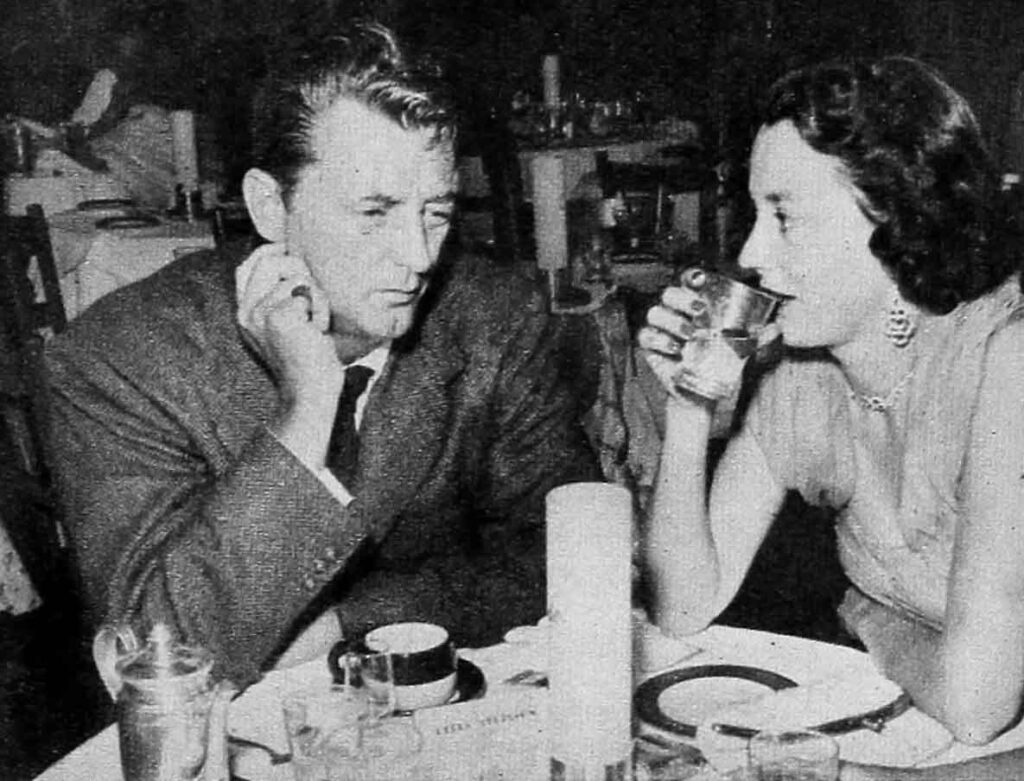
Bob pretends to treat homelife carelessly, leave family worries to Dorothy. But he has been seen feeding the baby, king like a model father with his sons.
Like millions of American mothers with frayed nerves, praying for strength to hold out until mischief-laden children were back in their classrooms, Dorothy thought she wasn’t going to make it. Their two sons, Jim, twelve, and Chris, ten, had been in her hair ever since they got up. “And I can’t stand it any more!” she ended.
Now Bob was in the middle of shooting River Of No Return, with Marilyn Monroe and Rory Calhoun. Because of injuries to both Marilyn and Rory the picture was behind schedule and the whole company was working hard to catch up. Besides, Bob was Bob. Was he going to let Dorothy dump two rambunctious boys on him?
Naturally not. Naturally he would shrug off his wife’s plea and say, “Too bad. We all have our troubles. Right now I’m busy and the kids are yours.” You leaned back and waited for him to say it.
But he didn’t. Dutifully and considerately, he talked to his wife. “All right,” he said. “Throw the boys into the car and send them to the studio. I’ll take care of them for the rest of the day.”
What’s this, a new angle on Bob? You ask him and he dismisses your query with a wave of his hand. “Ah, they won’t bother me. I won’t even know they’re here.”
But it isn’t a new angle. It’s an old angle and it’s becoming obvious. It’s repeated too often. When Bob went to Canada, to Banff and Jasper National Park for the outdoor scenes in River Of No Return, he took Dorothy and their baby daughter, eighteen-month-old Petrene. A Hollywood resident on the same train said he saw Bob many times, holding the baby on his shoulder and lulling her to sleep, seating her on his lap in the dining car and carefully feeding her, and shepherding Dorothy and the baby every time they walked through the train.
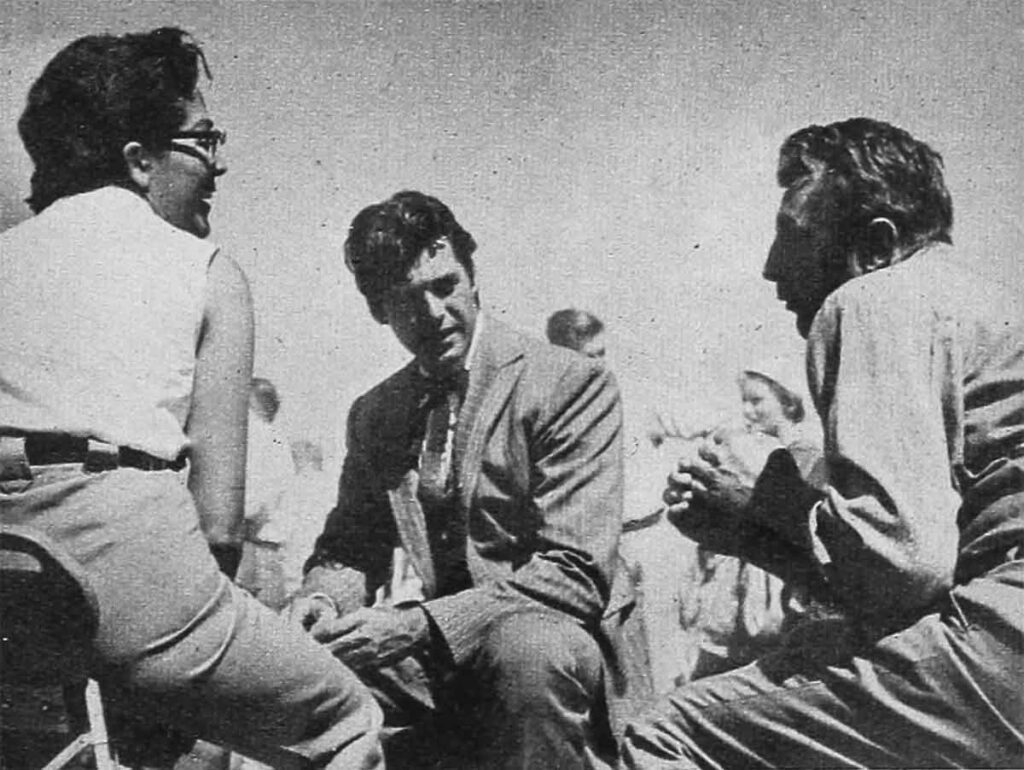
Self-styled toughie, Bob is a very dependable actor, lets nothing keep him from work. On location with Rory Calhoun and Marilyn Monroe he even refrained from wolf whistles.
“It’s a brand new life with every breath I draw,” Bob is fond of saying. “Who can worry about things?” This is the popular conception of him—a fellow who lives for himself, who doesn’t know what’s going on around him, and doesn’t care. There was a director on one of Bob’s pictures who believed this. When an electrician up on a catwalk accidentally shifted a floodlight noisily during the filming of a scene, the director furiously ordered that he be fired on the spot. No one suspected that Bob, languidly breaking out of his role, was paying the slightest attention to what was going on. But when the electrician walked off the set Bob reached for his coat and lazily strolled away, too.
The director chased after him. “Where are you going?” he demanded. “I haven’t called a break yet. We’re not through with the scene!”
Bob kept on walking. “You haven’t got a crew,” he said, without even turning his head. “Can’t make a picture without a crew.”
“We’ve got a crew!” the director ranted. “There! Look back.”
“Not a complete crew,” said Bob. “Can’t make a picture without a complete crew.”
The director wasn’t stupid. He didn’t have to mull over Bob’s words to get the idea, but he was an egotist (which he isn’t any more, by the way) and no actor was going to get the best of him. He reported Bob to the studio heads. The studio heads held a meeting and made a decision. Late that afternoon the director’s assistant knocked on Bob’s door. The crew, a “complete” crew was waiting to go ahead. But Bob hadn’t finished yet. The assistant director relayed Bob’s question to the director.
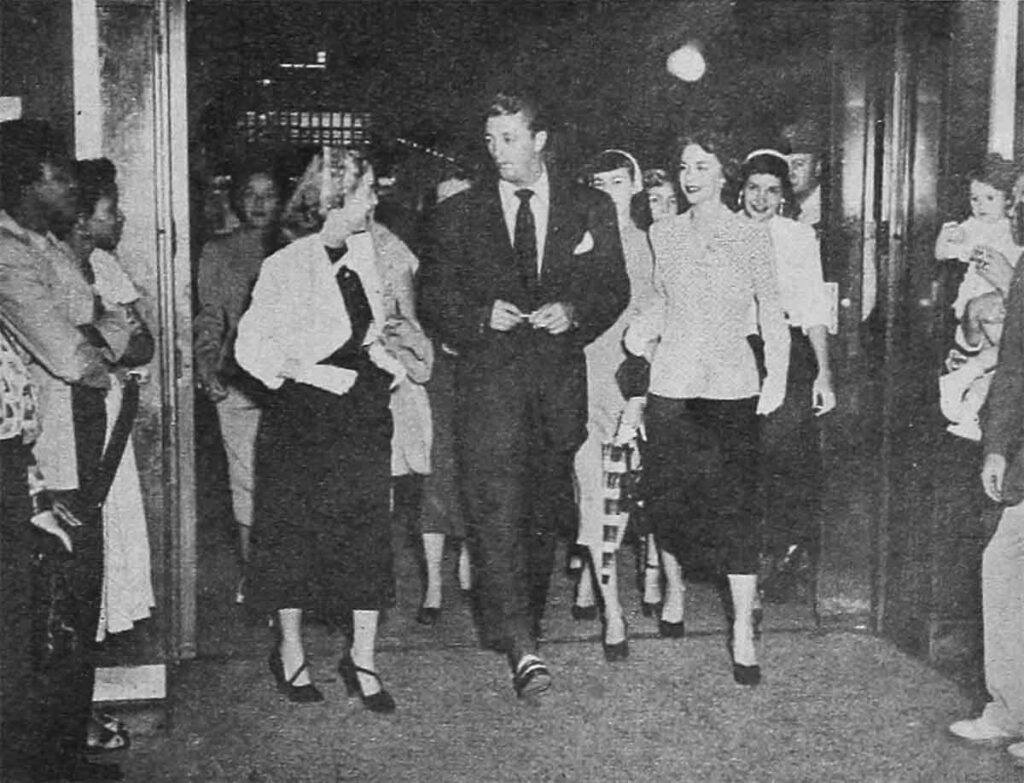
Bob’s directors know the only safe person to bawl out is Bob himself; “blackhearted” Mitchum has walked off sets to protest unfair treatment of crew members by higher-ups.
“Mr. Mitchum wants to know if it is a happy crew,” he said. “Mr. Mitchum thinks its unwise to work with a crew unless every member of it is happy.”
The director threw up his hands and that was the beginning of his reformation. He apologized to the electrician whom he had already restored to his job. Word was sent to Bob who returned without the slightest hint in his expression that anything unusual had happened.
There are dozens of stories of this kind that could be told to show that Bob fabricates when he makes of himself a hard case, insensitive to his fellow men. He has demonstrated the opposite so thoroughly that the working people in the studios feel that he can do no wrong. You’d feel the same way if you were one of them and knew that when the director feels like bawling out someone it will never be you. He has long since learned, as have all Mitchum directors, that when he loses his temper the safest fellow to yell at is Bob himself. All that happens then is that Bob yells back. But if the director turns on someone he doesn’t consider important enough to defend himself, and especially when his wrath takes an unreasonable direction, he may have to close up shop. His star may take a walk.
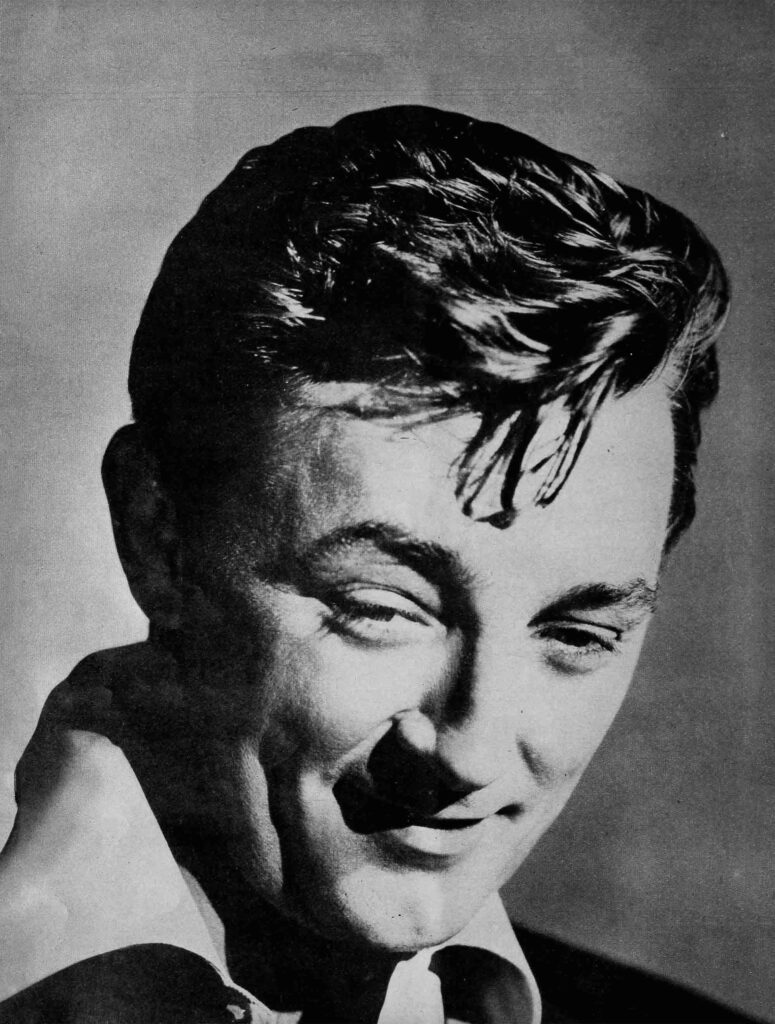
This is not the complete story of Bob in his relationship to those with whom he lives and works. This would class him as just another of those stars who defend the small fry because they like to be known as “very democratic.” With Bob this sort of pose is unnecessary. Without trying, he is as democratic as an old pair of socks. By instinct, he is for the little guy, but he is not unaware that the big guy has a job to do, too. He has been steadily gaining stature in the eyes of his directors because when the moment comes for the cameras to roll—he delivers.
To say that his acting is good is to enter the realm of opinion. To reveal that he spends from two to four weeks with every script, studying it until he knows not only every word, but all the flavors they could possibly come in, is just repeating somebody’s claim. To add that a lot of people think he should have his name on some of his scripts as a writer because he has contributed so much to the dialogue and plot, is quoting opinion again. But there are some facts about his value as an actor which can be given in the form of cold figures.
He practically never misses a line. In River Of No Return he had 184 speeches and delivered every one without a flub. A more exciting demonstration of his amazing memory took place during the filming of White Witch Doctor in which he starred opposite Susan Hayward. The script required that he speak a whole page of dialogue in Bakuba, an African dialect. His speech was typed out phonetically in English and handed to him at nine o’clock in the morning. To one unfamiliar with Bakuba, as Bob was, it meant nothing but a couple of hundred odd, guttural sounds. A half hour later he was in front of the camera, tearing off his speech without a mistake, and without any idea of what any sound meant.
There is no use in trying to get Bob to admit that he is a pretty good fellow, hard working, and with decent instincts in his possession. You can’t even trap him into it. “Say, I heard that you had a good record when you worked at Lockheed before you got into pictures,” a cameraman once told him—almost accusingly. “You were there more than a year. You couldn’t have been as breezy and unconcerned as you keep pretending.”
“Aw, they only kept me on because I was frozen on the job by war regulations,” Bob replied. “I was horrible.”
Yet, some of the fellows who worked with Bob at Lockheed remember that after starting as an unskilled hand he was soon in charge of fifteen men. You don’t get supervisory jobs like that lounging around and ducking your responsibilities.
Bob’s wild and incriminatory stories about himself give interviewers a weird time. Last winter, a reporter spent two hours with him over a luncheon table and failed to get one statement from Bob that wouldn’t be practically libelous if it were printed. He finally put away his pencil and pad with the weary remark that he hadn’t a thing to write—the interview was a failure. For the first time since they had sat down, Bob grew serious.
“You’re stuck, huh?” he asked.
“Sure,” the reporter replied. “There’s nothing here I can use.”
“Tell you what,” offered Bob. “Come to dinner at my home. Sit down with the family. Talk to anyone. Look at anything you want to. Ask anything you like. If I don’t make sense ask my wife, the boys, the maid. Somebody ought to give you a straight answer.”
Sometime later a friend asked the reporter if he had had the dinner with Bob.
“I did,” the reporter said. “I got a good story of Bob as he is with his family, when he is relaxed and at home. And when it was time to go he realized it was cold outside and I had come without a topcoat. He insisted on lending me one of his. But I had to promise not to put that in the story.”
All over Hollywood, you run across fellows with little tales like that. There is the publicity man at RKO who was rushed to the hospital for an emergency appendectomy. He knew Bob but didn’t hear from him until the day he was getting ready to leave the hospital. Then the telephone rang.
“What do you plan to do now?” Bob wanted to know.
“Oh, go home and recuperate for a week or so before I go back to work,” was the reply.
“How are you going to recuperate?” Bob asked. “You’re a bachelor and you live alone. You’ll probably bust your stitches trying to wait on yourself. What you’d better do is come to my place till you’re on your feet. I’ve got a wife and a maid. They’ll take care of you.”
It’s a typical Mitchum gesture, but typically, nobody knew about it till the publicity man let it slip in an unguarded moment. Anyone who works with Bob knows that these are things he doesn’t want spread about. If you ask his secretary, Reva Fredericks, she’ll tell you, laughingly, that he is a monster. But Reva is one of the best-informed and most capable secretaries in Hollywood and she doesn’t have to stay with Bob Mitchum. Everyone knows she has been called by every agent in town to come to work for one of their stars at twice the salary Bob can afford to pay her. Why doesn’t she leave “the monster”? Her answer is “No comment.” But other people have already commented. They say her employer is soft and easygoing whereas the average star reacts to professional worries by turning into a nervous, carping taskmaker. No one has ever seen Bob nervous or in a tantrum.
Little by little, Hollywood is catching on to the well known Mitchum and the little known Mitchum. And Bob is becoming aware of it, too. His attitude that nothing is important, much less himself, earns the skeptical stare more often than not. But he still keeps on. A man who has known him ever since he came to Hollywood pointed out that he must keep on.
“Bob, in a sense, is the victim of his intelligence,” said this friend. “If he were a less intelligent man he could accept his fabulous rise as a natural consequence of superior artistry and talent. But Bob can’t fool himself that way. He remembers exactly how much luck had to do with it and he knows that if it were not for a few fortunate twists of fate he still might be living in the chicken coop he had to clean and cover with tar paper for his bride when they first came to California. When Bob waxes cynical he is hooting at his own success. Bob, the man, loves to rib Bob, the star, maybe to make sure t hey both keep their feet on the ground.”
THE END
—BY LOUIS POLLOCK
It is a quote. MODERN SCREEN MAGAZINE DECEMBER 1953